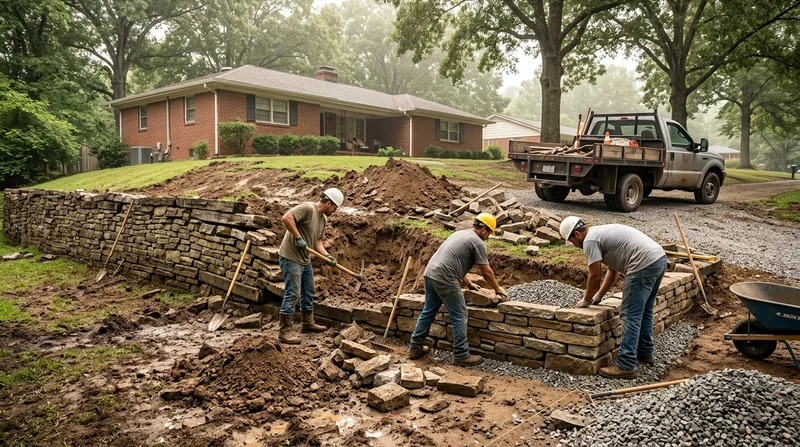




Memphis sits on the Chickasaw Bluffs above the Mississippi River, and that geography is hard on retaining walls. The soil here is deep wind-blown loess silt layered over clay, cut by steep ravines and creek channels. When spring thunderstorms dump rain, that loess saturates, slumps, and pushes hard against any wall holding a driveway cut or a terraced yard. If you have a Leaning & Collapsed Wall Repair in Memphis problem, you are watching hydrostatic pressure and soil movement win a fight your wall was never built to handle. We respond fast to stabilize, correct drainage, and rebuild when a wall is past saving. Whether it is a poured concrete wall on a bluff cut near Victorian Village or a segmental block terrace in Cordova, we read the failure and fix the cause, not just the symptom. Call (901) 519-2101 for priority response. You can also review our full retaining wall repair capabilities before you call.
Why Leaning and Collapsed Walls Are a Memphis Problem, Not Just an Eyesore
Most wall failures in Memphis trace back to water and soil, not bad block. The loess silt on the bluffs erodes and slumps when saturated, and the expansive clay beneath it swells and shrinks with every wet and dry cycle. Add torrential spring storms and long humid summers, and a wall that looked fine in October can bulge by April. In the low bottomland near the Wolf River, Loosahatchie, and Nonconnah, a high water table keeps soils wet year-round and drains never get a chance to work.
- Hydrostatic pressure builds behind the wall when drainage stone and weep holes clog with silt.
- Loess soils lose bearing strength fast when saturated, so footings settle and walls rotate outward.
- Expansive clay pushes against the back of the wall and cracks mortar joints and block faces.
- Tree roots and aging timber or railroad tie walls rot and give way without warning.
- Driveway cuts on the bluffs concentrate runoff, which scours the footing and undermines the base.
Ignoring a lean lets a repairable wall become a full collapse, and a full collapse can take a driveway, a fence, or a slab with it.
Key info: A 1920s Tudor in Central Gardens had a fieldstone garden wall bulging 4 inches after a wet spring. The culprit was a clogged French drain behind the wall, not the stone itself. We relieved the pressure, reset the stone, and rebuilt the drain, and the wall has held through three storm seasons since.
For official guidance on when a retaining wall needs a permit in your jurisdiction, check the Shelby County government site and confirm with your local building department, since thresholds vary by municipality.
How We Stabilize and Rebuild a Failing Wall in Memphis
We start by finding out why the wall moved, because a lean is a symptom, not the disease. On the bluffs, that usually means saturated loess and a failed drain. In Cordova or Germantown, it is often clay pressure and a footing that was never deep enough. We dig test pits, check the footing, and map where the water is going before we touch a single block.
- We assess the wall, the soil, and the drainage, and we tell you plainly whether it can be stabilized or needs a rebuild.
- We relieve hydrostatic pressure by clearing weep holes and installing or replacing drainage stone and perforated pipe.
- We install tieback anchors or helical anchors to pull a leaning wall back to plumb when the structure is sound.
- We rebuild the footing and base course when settlement or scour has undermined the wall.
- We replace failed sections with block, concrete, or stone matched to the existing wall and the site.
- We restore grading and surface drainage so runoff moves away from the wall instead of into it.
Every job ends with a drainage check, because a dry wall is a wall that stays put.
Key info: A homeowner in Bartlett had a timber terrace collapsing into a ravine behind the house. We stabilized the slope, replaced the failed timber with segmental block, and tied the new drainage into the existing storm line. See our slope stabilization work for similar ravine sites.
Repair Approaches We Use on Memphis Walls
Not every wall needs the same fix. We match the approach to the failure mode, the wall material, and what the site will allow. Here is how the main options compare.
| Approach | Description | Best for |
|---|---|---|
| Tieback anchoring | Steel anchors driven into stable soil pull a leaning wall back toward plumb. | Walls that are cracked or leaning but structurally sound. |
| Drainage correction | Weep holes, drain stone, and perforated pipe relieve hydrostatic pressure behind the wall. | Bulging walls with water pushing from behind. |
| Partial rebuild | Failed sections and footing are removed and rebuilt to match the existing wall. | Localized collapse or settlement at one end. |
| Full replacement | The wall comes out and a new wall with proper footing and drainage goes in. | Walls past saving, including rotted timber and railroad tie walls. |
| Soil reinforcement | Geogrid and engineered backfill stabilize the soil mass the wall holds. | Tall walls and walls under driveway or structure surcharge. |
We will tell you which approach fits your wall after we see it, not before.
Leaning & Collapsed Wall Repair Cost in Memphis: What to Expect
Pricing for leaning and collapsed wall repair starts at From $2,500 for stabilization and drainage work on a smaller wall. That figure covers the assessment, pressure relief, drainage correction, and anchoring on a typical residential wall up to about 4 feet. Costs climb with wall height, length, and access, and with whether the footing needs rebuilding. A full rebuild on a tall bluff wall can run several times that starting figure.
The biggest cost drivers are wall height and length, how much of the wall has failed, and whether we can get equipment to the site. A wall behind a house in Midtown with narrow alley access costs more to fix than a wall at the front of a Collierville lot. Saturated loess and high water table sites also take more excavation and drainage work. Get two or three written estimates, ask what each one covers, and be wary of a low bid that skips drainage, because that is the repair that keeps the wall standing. Our pricing page breaks down typical ranges in more detail.
Hiring a Retaining Wall Contractor Near Me in Memphis: What to Check
When you search for retaining wall repair near me in Memphis, you will get a long list of names. Narrow it down by checking the basics before anyone touches your wall. A leaning wall is a structural problem, and the wrong crew can make it worse or leave you with a collapse and no recourse.
- Confirm the contractor is fully insured, and ask for a certificate of insurance before work starts.
- Get at least two or three written estimates that spell out the repair method, drainage work, and cleanup.
- Ask for references from jobs in Memphis and the surrounding suburbs, and call them.
- Ask who pulls the permit if your wall is above the local height threshold or supports a driveway.
- Check HOA rules before you rebuild, since some Cordova and Germantown subdivisions restrict wall materials and heights.
A contractor who answers these questions straight is the one you want holding the shovel. Reach out through our contact page to schedule a free estimate.
Leaning & Collapsed Wall Repair in Memphis: Pricing Guide
| Service | Price | Details |
|---|---|---|
| Stabilization and drainage repair | Starting at $2,500 | Covers assessment, pressure relief, drainage correction, and anchoring on a typical residential wall. |
| Partial rebuild | Starting at $4,500 | Removes and rebuilds failed sections and footing; price rises with wall height and access. |
| Full wall replacement | On estimate | Needs an on-site look to price footing depth, drainage, and equipment access. |
| Emergency stabilization | On estimate | Priority response to prevent collapse; urgency and site conditions drive the final number. |
| Travel | Included | In Memphis and surrounding areas, no separate call-out or mileage fee. |
| Estimate | Free | Response within 24h at (901) 519-2101, no obligation to book. |
Indicative pricing, the exact cost depends on square footage, finish, and site access. Free personalized estimate within 24h at (901) 519-2101.


