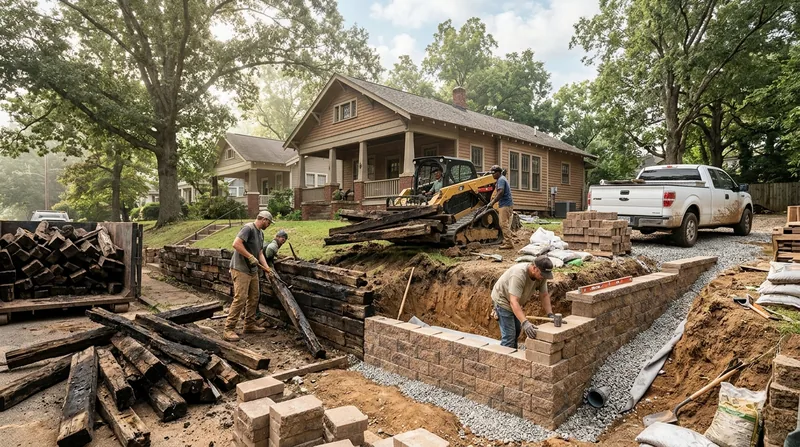




Memphis sits on the Chickasaw Bluffs above the Mississippi River, where deep wind-blown loess silt over clay gets cut by steep ravines and creek channels. That geology matters for every wall in the city. In Cooper-Young, Midtown, and Central Gardens, we still find railroad tie terraces from the 1970s and 1980s holding up backyards behind bungalows and Tudors. Those creosote-soaked ties rot, shift, and slump when the loess saturates after a spring thunderstorm. Railroad Tie Wall Replacement in Memphis means pulling out the old ties, hauling them off, fixing the drainage, and rebuilding in segmental block, poured concrete, or natural stone. We handle the demolition, the gravel backfill, and the new wall, start to finish. If a tie wall is leaning or already collapsing, start with leaning and collapsed wall repair before the yard washes out.
Why Railroad Tie Walls Fail in Memphis: Loess, Clay, and Forty Years of Rot
Creosote-treated ties were sold as a cheap way to terrace a sloped Memphis yard, and for twenty years they worked. After forty, they do not. The loess silt behind them erodes and slumps when saturated, the clay beneath swells and pushes, and the ties themselves check, split, and rot from the inside. The dominant failure mode here is saturated loess slumping behind a rotted tie face, usually after a March or April storm dumps two inches in an hour.
- Creosote ties leach and soften, then lose their structural grip on the soil behind them.
- Original tie walls rarely had gravel backfill or drain tile, so hydrostatic pressure builds with every rain.
- Memphis clay swells in wet seasons and shrinks in dry ones, ratcheting the wall outward year after year.
- Ravine-edge lots in Midtown and East Memphis lose soil under the ties, leaving voids and a hollow sound when you walk the terrace.
- Many 1970s tie walls were stacked two or three high without geogrid, which no modern code allows above roughly 4 feet.
If you can push a screwdriver into a tie by hand, the wall is past repair and needs replacement, not another coat of stain.
Key info: A 1982 tie wall on a ravine lot off Central Avenue in Midtown had lost 14 inches of soil behind the top course. The homeowner thought the wall was fine because the ties looked solid from the yard side. The backfill had already washed out.
Permits for walls above roughly 4 feet, or walls that support a driveway or structure, come from the local building department, and thresholds vary by jurisdiction. Check the Shelby County government site or your city's building department before any rebuild.
How We Replace a Railroad Tie Wall in Memphis, Step by Step
We do not stack new block on top of old ties or old fill. A tie wall replacement is a full tear-out: ties out, rotted organic fill out, footing inspected, drainage rebuilt, new wall engineered for the load behind it. On the bluff lots in Victorian Village and Chickasaw Gardens, that often means hand-digging because equipment cannot get through a 36-inch gate.
- We walk the wall and the slope above it, check for voids, and measure the height from the footing to the top of the soil.
- We pull the permit if the wall exceeds the local threshold or carries a surcharge such as a driveway or patio.
- We cut and remove the creosote ties, load them out, and haul them to a permitted disposal site.
- We excavate the failed backfill down to stable soil and inspect the existing footing or pour a new one.
- We install drain tile, washed gravel, and filter fabric so water leaves the wall instead of pushing it out.
- We build the new wall in segmental block, poured concrete, or natural stone, with geogrid where the height or load requires it.
- We backfill in compacted lifts, restore the grade, and walk the finished wall with you before we leave.
Every tie wall we replace gets new drainage, because the old wall failed from water long before it failed from age. See how we handle that on the retaining wall drainage page.
Key info: In Cordova and Bartlett, subdivision tie walls often sit on property lines with HOA rules about wall height and material. We check the plat and the HOA covenants before we order block, not after.
Replacement Approaches We Use on Memphis Tie Walls
Not every tie wall should be rebuilt the same way. A low garden terrace behind a Cooper-Young bungalow and a 6-foot bluff-edge wall in Chickasaw Gardens are different jobs with different loads. Here is how we match the approach to the site.
| Approach | Description | Best for |
|---|---|---|
| Segmental block replacement | Ties out, gravel and drain tile in, engineered block wall with geogrid as needed. | Suburban terraces in Germantown, Collierville, and Arlington where height and load are moderate. |
| Poured concrete replacement | Formed and poured wall on a new footing, with weep holes and gravel backfill. | Driveway cuts and bluff-edge walls in East Memphis that carry a surcharge. |
| Natural stone replacement | Fieldstone or Crab Orchard stone laid on a new base with hidden drainage. | Garden terraces in Central Gardens and Midtown where the look matters as much as the structure. |
| Tie-for-tie timber rebuild | New pressure-treated timbers, new gravel, new drain tile, same footprint. | Low garden walls under 3 feet where the homeowner wants to keep the timber look. |
| Tiered replacement with slope work | Two or three shorter walls plus regrading and erosion control on the slope above. | Ravine lots and steep Wolf River bottomland yards where one tall wall is not the answer. |
We pick the approach after we see the soil, the slope, and what the wall has to hold up, not before.
Railroad Tie Wall Replacement Cost in Memphis: What to Expect
Most tie wall replacements in Memphis start around $35 per square foot of wall face, and that figure moves with height, access, and what is behind the wall. A 30-foot wall at 3 feet high in Bartlett is a different number than a 6-foot bluff-edge wall in Chickasaw Gardens that needs engineering and a concrete footing. Treat any quote given over the phone without a site visit as a guess.
- Wall height and total square footage drive the base cost more than anything else.
- Access matters: a backyard reachable only through a 36-inch gate means hand-carrying block and hauling ties out by wheelbarrow.
- Soil conditions add cost when the loess has slumped and the excavation runs deeper than expected.
- Drainage and geogrid are not optional on a proper replacement, and they are priced in.
- Tie disposal carries a fee because creosote-treated wood cannot go in a standard curbside pickup.
- Engineered drawings, when the local building department requires them for a tall or tiered wall, add design cost.
Get two or three written estimates on the same scope so you are comparing the same wall, the same drainage, and the same disposal. Our full pricing overview breaks down how the numbers stack up.
Hiring a Retaining Wall Contractor Near Me in Memphis: What to Check
Anybody with a truck can pull ties out of a Memphis yard. Rebuilding the wall so it holds the slope for the next forty years takes a contractor who understands loess, clay, and drainage. Ask questions before you sign anything, and do not let a low bid talk you out of the permit or the gravel backfill.
- Confirm the contractor is fully insured, and ask for a certificate of insurance before work starts.
- Get at least two or three written estimates that itemize demolition, disposal, drainage, and the new wall.
- Ask for references from jobs in Memphis or the surrounding suburbs and call them.
- Find out who pulls the permit, and confirm the wall height threshold with the local building department.
- Check HOA covenants in Cordova, Lakeland, or Arlington before you pick a wall material or height.
- Ask where the creosote ties go, because a contractor who cannot answer that is not handling disposal legally.
When you are ready to talk through your wall, contact us for a free estimate and we will walk the site with you.
Railroad Tie Wall Replacement in Memphis: Pricing Guide
| Service | Price | Details |
|---|---|---|
| Railroad tie wall replacement, standard access | Starting at $35/sq ft | Includes tie demolition, haul-away, gravel backfill, drain tile, and new segmental block wall on typical lots. |
| Tie wall replacement, restricted access | Starting at $45/sq ft | Hand-carry of block and wheelbarrow haul-out through narrow gates or tight Midtown side yards. |
| Poured concrete or engineered replacement | On estimate | Tall or surcharge walls need a site visit, footing design, and possibly engineered drawings before pricing. |
| Tiered replacement with slope stabilization | On estimate | Ravine and bluff-edge lots need regrading and erosion control assessed on site before any number. |
| Travel | Included | In Memphis and surrounding areas, no separate call-out or mileage fee. |
| Estimate | Free | Response within 24h at (901) 519-2101, no obligation to book. |
Indicative pricing, the exact cost depends on square footage, finish, and site access. Free personalized estimate within 24h at (901) 519-2101.


