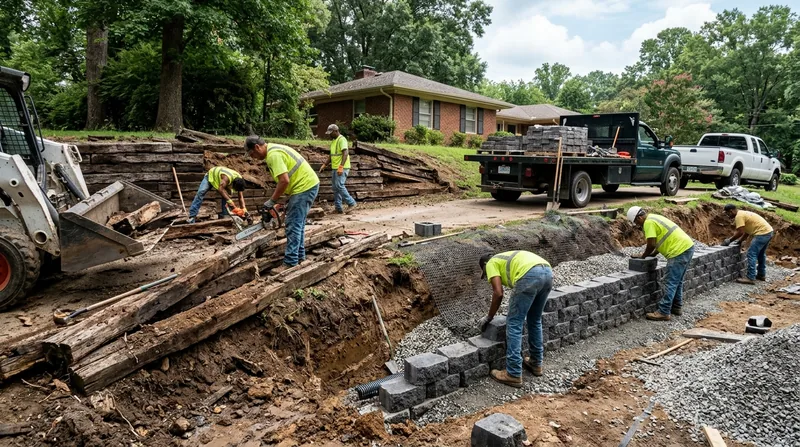




Retaining Wall Replacement in Memphis: Tear Out the Old, Build It Right
Memphis sits on the Chickasaw Bluffs, where deep wind-blown loess silt caps swelling clay and steep ravines cut down toward the Mississippi. That geology is why so many walls across Midtown, Central Gardens, and the bluff streets above the river are leaning, bulging, or already collapsed. If your wall has passed the point of patching, Retaining Wall Replacement in Memphis means a full tear-out, proper drainage, and a new wall engineered for this soil. We handle railroad tie and timber terraces in Cooper-Young, poured concrete driveway cuts in Chickasaw Gardens, and segmental block walls in Cordova and Germantown. One failed wall can take a driveway, a patio, or a foundation with it, so timing matters. If the wall is still standing but moving, start with retaining wall repair before replacement becomes the only option.
Why Walls Fail Here: Loess, Clay, and Memphis Thunderstorms
The dominant failure mode in Memphis is saturated loess slumping behind a wall that was never built to drain. Loess loses strength fast when water gets in, and our spring thunderstorms dump inches in hours. Add clay that swells through wet and dry cycles, and you get the bowed block walls and rotting tie terraces we tear out every week. The low bottomland near the Wolf River and Nonconnah Creek is worse, because the water table sits high and keeps the soil wet year round.
- Rotting railroad tie and timber walls fail first because the wood decays from the back where you cannot see it.
- Poured concrete and CMU walls crack when hydrostatic pressure builds with no relief path.
- Segmental block walls bulge and lean when the base course was not set on compacted, drained gravel.
- Fieldstone garden walls in older neighborhoods settle when the loess underneath erodes and washes out.
Any wall showing two or more of these signs is a replacement candidate, not a repair candidate. The City of Memphis and Shelby County building department sets the permit threshold, and we verify it for every job before we pull a shovel.
Key info: A 1970s railroad tie terrace behind a Colonial Revival in Central Gardens was holding back six feet of saturated loess. The ties had rotted through and the wall was pushing into the patio. We tore it out, hauled the debris, and replaced it with a drained segmental block wall set on a compacted gravel base.
How We Replace a Failed Wall in Memphis, Step by Step
Every replacement starts with an on-site look at the soil, the slope, and what the wall is holding up. We check for utilities, measure the wall height from the footing, and confirm whether a surcharge like a driveway or structure means engineered drawings are needed. Then we build the sequence around your access, your schedule, and the weather window.
- We walk the site with you and photograph the failure points, then confirm permit requirements with the local building department.
- We disconnect and protect anything attached, then demolish the old wall and haul every tie, block, and chunk of concrete away.
- We excavate to stable soil, shape and compact the base, and set new drainage gravel and perforated pipe with a proper outlet.
- We build the new wall in lifts, compacting backfill as we go so the soil does not settle later.
- We restore the grade, replace disturbed landscaping, and walk the finished wall with you.
For a wall on a steep bluff cut, that sequence often means staging materials from the street and hand-carrying them down. For a flat suburban yard in Bartlett or Arlington, we can bring equipment right to the wall.
Key info: A leaning timber wall in Collierville was holding a raised planting bed against the house. We tore it out, reset the grade, and built a drained block wall with a stone cap. The homeowner got their side yard back and stopped the water tracking toward the foundation. See our Collierville retaining wall replacement work.
Replacement Approaches We Use
The right replacement material depends on wall height, soil, load, and how the wall looks against the house. We match the approach to the site instead of forcing one system onto every yard.
| Approach | Description | Best for |
|---|---|---|
| Segmental block replacement | Engineered block on a compacted gravel base with geogrid and drainage. | Suburban terraces and driveway cuts in Cordova, Germantown, and Arlington. |
| Poured concrete replacement | Reinforced concrete wall with formed footing and weep drainage. | Tall walls, structural surcharges, and tight bluff-side lots. |
| Boulder and natural stone replacement | Fieldstone or Crab Orchard stone reset over a drained, compacted base. | Garden walls in Midtown and Central Gardens where the look matters. |
| Timber to block conversion | Old railroad ties and landscape timbers removed, replaced with block. | Aging tie terraces in Cooper-Young and Whitehaven that have rotted through. |
| Tiered wall rebuild | Multiple short walls rebuilt with proper setbacks and drainage between tiers. | Steep ravine lots where one tall wall would be overbuilt. |
Every one of these approaches includes new drainage, because a replacement wall without drainage is a repeat failure waiting to happen.
Retaining Wall Replacement Cost in Memphis: What to Expect
Replacement pricing starts at From $35 per square foot of wall face, and that figure covers demolition, haul-away, base prep, drainage, and the new wall. From there, the number moves with wall height, access, soil conditions, and material choice. A short garden wall in East Memphis sits near the low end; a tall, engineered wall on a bluff cut with limited access runs higher because of excavation, geogrid, and hand work.
- Wall height and length drive the square footage and the engineering requirements.
- Access matters: a backyard wall in Frayser with no equipment path costs more in labor than a street-facing wall.
- Soil conditions add cost when saturated loess requires over-excavation to reach stable ground.
- Material choice moves the price between segmental block, poured concrete, and natural stone.
- Permits and engineered drawings add a line item on tall or surcharge-loaded walls.
Get two or three estimates and compare what each one includes, especially drainage and haul-away, because a low bid that skips drainage is not a real comparison. Our full retaining wall pricing overview breaks down the ranges in more detail.
Retaining Wall Replacement Near Me: How to Pick a Contractor in Memphis
When you search for retaining wall replacement near me, the list of names can look the same. What separates them is paperwork, references, and whether they understand local permits and soil. Ask direct questions and expect direct answers before anyone touches your wall.
- Confirm the contractor is fully insured and ask for a certificate of insurance before work starts.
- Get at least three written estimates that itemize demolition, drainage, materials, and haul-away.
- Ask for references from jobs in your part of town, ideally walls similar in height and soil.
- Ask who pulls the permit and whether the local building department requires engineered drawings for your wall height.
- Check HOA rules for wall height, material, and setbacks before you sign anything.
A contractor who hesitates on any of these is telling you something. Reach out through our contact page and we will walk your wall and give you a straight answer.
Key info: In Germantown and Lakeland, HOA rules often cap wall height and require a specific block color. We confirm those rules before ordering material so the finished wall passes inspection and the HOA review the first time.
When Repair Is the Smarter Call
Replacement is not always the answer. A wall with a cracked cap, a clogged drain, or one settled section can often be stabilized for a fraction of the cost. We tell you which category your wall falls into after we look at it, not before. If the wall is leaning badly or has already collapsed, see our leaning and collapsed wall repair page for the emergency path. For walls that are structurally sound but holding water, retaining wall drainage work often solves the problem. Call (901) 519-2101 and we will tell you honestly whether you need a replacement or a repair.
Retaining Wall Replacement in Memphis: Pricing Guide
| Service | Price | Details |
|---|---|---|
| Timber or railroad tie wall replacement | Starting at $35/sq ft | Includes tear-out, haul-away, new drainage, and segmental block rebuild on compacted base |
| Segmental block wall replacement | Starting at $40/sq ft | Engineered block, gravel base, geogrid as needed, and perforated drain with outlet |
| Poured concrete wall replacement | Starting at $55/sq ft | Reinforced concrete with formed footing and weep drainage; height and surcharge move the price |
| Boulder and natural stone replacement | Starting at $60/sq ft | Fieldstone or Crab Orchard stone reset over drained base; access and stone sourcing affect cost |
| Complex or large-scale job | On estimate | Tall, tiered, or bluff-side walls need an on-site look, soil check, and engineering review first |
| Estimate | Free | On-site walkthrough and written quote, response within 24 hours at (901) 519-2101 |
Indicative pricing, the exact cost depends on square footage, finish, and site access. Free personalized estimate within 24h at (901) 519-2101.


