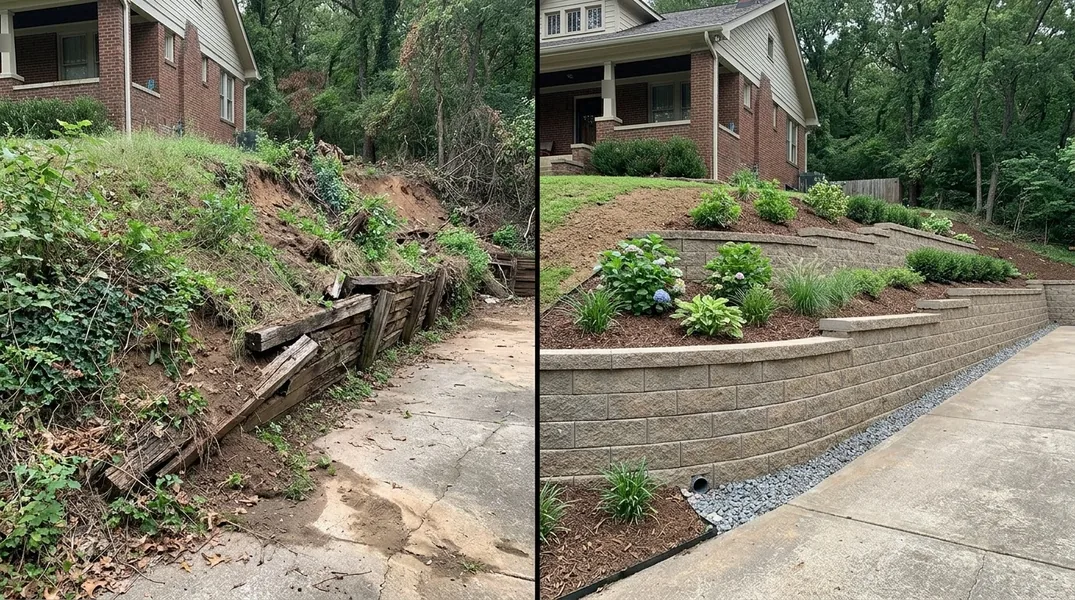
Why Memphis Thunderstorm Season Is So Hard on Retaining Walls
If you have lived in Memphis for more than a summer, you already know the pattern: weeks of dry heat followed by violent afternoon thunderstorms that dump an inch or more of rain in under an hour. That cycle is brutal on soil, and it is especially brutal on retaining walls. The problem is not the rain itself. It is what happens to the water once it soaks into the ground behind your wall.
Most retaining walls in the Memphis area are built to hold back saturated clay soil. When that clay absorbs a heavy rainfall, it expands, gets heavier, and pushes outward against the back of the wall with tremendous force. Engineers call this hydrostatic pressure, and it is the single most common cause of retaining wall failure we see on service calls. A wall that looks perfectly fine in July can develop bulging, cracking, and leaning by September if the water behind it has nowhere to go.
How Hydrostatic Pressure Quietly Destroys a Wall
Think of your retaining wall as a dam holding back a reservoir of soil and water. When drainage is working correctly, rainwater flows down through the backfill and exits through weep holes or a drain pipe before it can build up. When drainage is blocked, clogged, or was never installed properly, that reservoir fills up. Water is heavy, roughly 62 pounds per cubic foot, and saturated soil is even heavier. The pressure builds evenly across the back of the wall and pushes it forward.
The damage usually starts small. You might notice a hairline crack in the mortar, a slight lean at the top, or soil washing out from between blocks. Left alone, hydrostatic pressure will eventually cause sections to bulge, blocks to shift, and in serious cases, the entire wall to collapse after a storm. This is why Retaining Wall Repair should never wait until the wall is visibly failing. By the time a wall is leaning, the drainage problem behind it has usually been developing for months or years.
The Role of a Retaining Wall French Drain
The most effective defense against hydrostatic pressure is a retaining wall french drain. This is a perforated pipe wrapped in filter fabric and set in a bed of gravel along the base of the wall, on the uphill side. Water flows into the gravel, enters the pipe through the perforations, and is carried away from the wall to a safe discharge point. Combined with properly graded backfill and a layer of drainage stone, a french drain gives rainwater a clear path out instead of letting it sit against the wall.
Many failed walls in Germantown and Collierville were built without any drainage at all, or with a pipe that was wrapped in the wrong fabric and clogged with fine clay within a season. Proper retaining wall drainage is not an optional upgrade. It is the difference between a wall that lasts decades and one that needs replacement after a few storm seasons. If you are planning a new wall, make sure drainage is part of the design from day one, not something added after problems appear.
Warning Signs Your Retaining Wall Drainage Is Failing
Homeowners often ask us how to tell whether their wall has a drainage problem before it becomes a crisis. The earliest signs are usually visible after a heavy rain. Look for water pooling at the base of the wall, soil washing out from between blocks or from the top of the wall, and dark, damp patches on the face of the wall that do not dry out. Rust stains on concrete or efflorescence, the white powdery residue that appears when water moves through masonry, are also red flags.
More serious signs include bulging sections, a noticeable lean, cracks that widen over time, and gates or fences attached to the wall that no longer close properly. If you see any of these, it is worth having a professional take a look before the next storm season. In Bartlett and across the Memphis area, we frequently find that a wall showing these symptoms can still be saved with targeted repairs and a new drainage system, but only if the problem is caught early.
Retaining Wall Repair Near Me: When to Call a Pro
Some homeowners try to solve drainage problems by drilling extra weep holes or piling gravel against the wall. Unfortunately, these fixes rarely address the real issue, which is water trapped deep in the backfill. A proper diagnosis requires understanding the soil, the slope, the wall height, and where the water is actually going. That is the kind of assessment a professional can provide quickly, and it can save you thousands compared to waiting for a collapse.
If your wall is showing any of the warning signs above, or if you are planning a new wall and want it built to handle Memphis storm seasons, call Memphis Retaining Wall at (901) 519-2101. We can evaluate your drainage, recommend the right fix, and provide a free estimate so you know exactly what to expect. For walls that are too far gone, we also handle full Retaining Wall Replacement with drainage built in correctly from the start.
Building It Right the First Time
The best way to avoid drainage failures is to build the wall correctly from the beginning. That means proper excavation, correctly graded backfill, a filter fabric that keeps clay out of the drainage stone, a perforated pipe sized for the wall and slope, and a discharge point that moves water away from the wall and the house. It also means choosing materials suited to the site. Concrete Retaining Walls are popular in this region because they handle saturated soil well when paired with a proper drainage system.
Whether you need a new wall, a drainage retrofit, or a full replacement, the team at Memphis Retaining Wall can help you understand your options and the pricing involved. Do not wait for the next round of thunderstorms to find out whether your wall can handle the water. A quick inspection now is far cheaper than a collapse later. Call (901) 519-2101 or visit the website to schedule your free estimate and protect your property before storm season hits.
Looking for a professional retaining wall contractor in Memphis? Memphis Retaining Wall responds fast for all your retaining wall needs.
Get a Free QuoteOur services: Retaining Wall Installation · Retaining Wall Repair · Retaining Wall Replacement